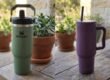
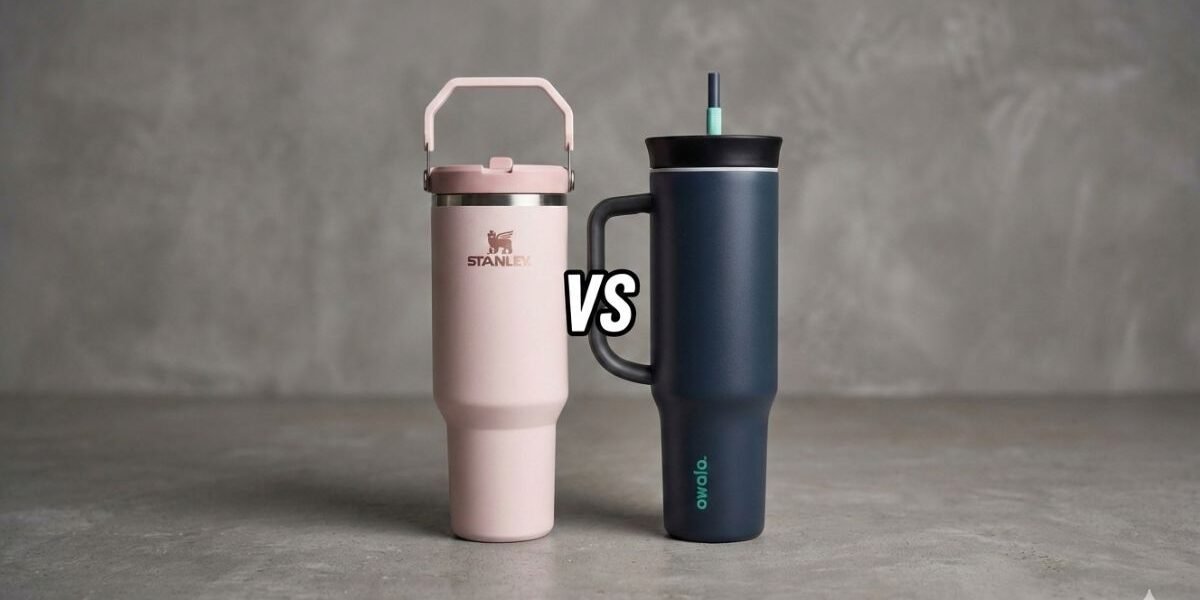
My collection tells the story at a glance: five Stanley tumblers in different sizes and just one lonely Owala. That imbalance pretty much sums up my experience. For me, Stanley has consistently been the better tumbler.
A quick clarification on Owala first. There are two versions available: the standard Owala Tumbler (the one I own) and the Owala FreeSip Tumbler. I haven’t purchased the FreeSip tumbler yet, but I do own the Owala FreeSip water bottle, which uses the same dual-drinking spout. Aside from the lid, the rest of the specs are nearly identical.
Even so, I doubt having the FreeSIP tumbler on hand would change my opinion. I don’t see it knocking the Stanley IceFlow off its pedestal anytime soon.
Within Stanley’s lineup—FlowState, ProTour, and IceFlow—the IceFlow remains my go-to. While the Owala tumbler has some thoughtful features, Stanley simply performs better in the areas that matter most to me.
Some of the links on this page are affiliate links. If you purchase them, I may earn a small commission at no extra cost to you.
Stanley vs Owala: Comparison Overview
| Feature | Stanley IceFlow 40 oz | Owala Tumbler 40 oz |
|---|---|---|
| Price | $45 | $40 |
| Material | 18/8 stainless steel | 18/8 stainless steel |
| Fits cup holders | Yes | Yes |
| Leakproof | Yes | No |
| Hot liquid compatible | Lid-dependent | Yes |
| Dishwasher safe | Yes | Yes |
| Warranty | Lifetime | Lifetime |
| My score | 4.6/5 | 4.2/5 |
Insulation Performance
Both tumblers comfortably belong in the “premium insulation” category. Stanley adds a twist by offering multiple lids, and insulation performance varies slightly depending on which one you use.
My favorite setup is the Stanley IceFlow paired with the flip straw lid. Starting with water at 37.8°F (3.2°C), it stayed below 59°F (15°C) for roughly 20 hours—without a single ice cube. That’s nearly double Stanley’s official 12-hour claim. With ice added, reaching the advertised two days of cold retention is completely realistic.
Hot performance is solid as well. In my testing, water dropped from 203.9°F (95.5°C) to 120.9°F (49.4°C) over 12 hours. Not scalding, but still very warm and enjoyable.
The caveat is the lid. Stanley only recommends the FlowState lid for hot liquids. My workaround is simple: flip straw for cold drinks, FlowState for hot ones. If you don’t already own the FlowState lid, it’s an additional purchase.
Owala holds its own here. In the hot test, it actually edged out Stanley slightly, finishing at 125.6°F (52°C) after 12 hours from the same starting temperature.
Cold retention is also impressive. Starting at 32.4°F (0.2°C), the water reached 65.1°F (18.4°C) after 24 hours—again, with no ice. Since my personal cutoff for “refreshing” is around 59°F (15°C), both tumblers realistically keep water cold for about 20 hours without ice. Add a few cubes, and you’ll easily exceed Owala’s claimed 24 hours.
Bottom line: insulation is essentially a tie. The differences are minor and unlikely to sway most buyers.
Lid Design & Leakproofness
This is where Stanley and Owala truly diverge.
Owala’s lid is undeniably clever. The chunky rim makes it easy to grip and twist, and you get two drinking options: sip through the straw or remove it, flip the tab, and chug directly from the opening. The flow rate is well balanced—neither overwhelming nor frustratingly slow.
The downside? When switching to chug mode, you’re left awkwardly holding the straw until you’re done. It’s not a dealbreaker, but it’s not exactly elegant.
Stanley IceFlow takes a more practical approach. The straw folds neatly into the lid, making it more hygienic and less awkward to toss into a bag. Folding straws do require a bit of planning—you’ll want to flip it up before driving—but the tradeoff is worth it.
Most importantly, Stanley’s lid is genuinely leakproof. Owala’s is more splash-resistant than secure. Knock it over, and it will leak—not catastrophically, but enough to ruin a laptop or bag.
For me, leakproofness beats clever design every time, and that’s where Stanley pulls ahead.
Portability
Surprisingly, Stanley comes out on top here as well.
The classic Stanley side handle doesn’t do much for portability, and Owala’s similar handle isn’t much better. Both are fine for short carries, but once the tumbler is full, your fingers will feel it quickly.
The Stanley IceFlow skips the side handle altogether and instead uses a bucket-style handle built into the lid. It’s wide, comfortable, and fits four fingers easily, making it far more pleasant to carry for longer stretches.
Owala isn’t bad on the move—it fits neatly into cup holders—but Stanley matches that while offering a more comfortable carry experience overall.
Ease of Cleaning
Cleaning is another area where small differences add up.
Owala’s lid is dishwasher safe, but the cup itself is hand-wash recommended. Stanley states that both the IceFlow cup and lid are dishwasher safe, which is convenient when you want the machine to do the work.
That said, I mostly hand-wash both. It only takes a couple of minutes, and it helps keep the finish looking new. When I do use the dishwasher for Stanley, I always place it on the top rack to avoid excess heat.
Both tumblers have wide mouths, so cleaning is easy with a sponge or bottle brush. The only extra step is the straw, but with a proper straw brush, it’s effortless and only adds a few seconds.
Durability
As expected from premium tumblers, both feel solid and dependable. The stainless steel construction is sturdy, the lids don’t feel flimsy, and the powder-coated finishes resist scratches while improving grip.
There’s nothing about either tumbler that raises concerns about longevity.
Versatility
Versatility is where Stanley really separates itself.
Two features make the difference: a truly leakproof lid and the bucket handle. Together, they give me total confidence to toss my Stanley into a backpack or gym bag without hesitation. Doing the same with Owala would be a gamble—and likely a messy one.
The bucket handle also makes carrying large volumes far easier, almost like holding a compact jug instead of a cup. Combined with leakproofness, it allows me to take the Stanley everywhere: gym sessions, hikes, commuting, car rides, and even public transport.
Owala, by contrast, feels better suited for stationary use—on a desk, picnic table, or carefully placed in a car cup holder.
Another advantage for Stanley is its ecosystem. I own multiple cups and three different lids—FlowState, ProTour Flip Straw, and IceFlow Flip Straw—all interchangeable as long as the size matches. That flexibility lets me customize my setup depending on the drink or situation. Owala locks you into a single lid design, which limits adaptability.
Both handle hot and cold drinks well, so insulation isn’t the deciding factor. Portability and flexibility are, and Stanley clearly wins there.
Pricing
Owala takes the price win at $40 for the 40-ounce size, compared to $45 for Stanley. That $5 difference is minor, especially considering what Stanley offers.
Ironically, the Owala felt like the more expensive mistake. Paying slightly more upfront for a tumbler you truly enjoy is better than buying a cheaper one, regretting it, and then spending another $30–$40 to replace it later.
Both brands include a limited lifetime warranty covering manufacturer defects, which adds peace of mind.
Stanley vs Owala: Final Verdict
After weighing everything, Stanley is the clear winner for me. I like Owala as a brand and own several of their products, but their tumbler—while good—doesn’t match the overall usability of the Stanley IceFlow.
The combination of leakproof design, interchangeable lids, and that excellent bucket handle gives Stanley a decisive edge in real-world use.